
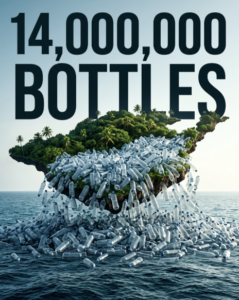
When you pick up a single-use plastic water bottle on a hot BVI day, it feels convenient and safe. When you drop it into a recycling bin afterward, you might walk away feeling satisfied, thinking: “It’s good, it’s being recycled.”
Here is the uncomfortable truth: Recycling PET plastic water bottles on an island is a financial drain, a technical nightmare, and an environmental band-aid.
While the collaborative We Recycle programme, facilitated by the Department of Waste Management and Green VI, works tirelessly to increase materials being diverted from our Tortola dumpsite that is dangerously at capacity, the hard data tells a stark story. It is time for all of us – households, business owners, and policy-makers – to look beyond recycling and examine the real impact of single-use PET plastic on our economy, our island, and our health.
New data released by Green VI and the Department of Waste Management has revealed a staggering statistic: since 2018, the territory’s “We Recycle” program has collected, baled, and exported almost 14 million single-use plastic water bottles.
1. The Hard Numbers: Why Exporting Plastic Waste Losses Money
 Many people assume recycled plastic is a valuable commodity that pays for its own transport. On a small island without plastic re-manufacturing plants, every single bottle must be collected, sorted, baled, and shipped thousands of miles across the ocean.
The We Recycle’s data reveals the stark economic reality of shipping PET plastic off-island:
- The Canada Shipments (2020–2024): Across 11 shipments totaling 249,467 lbs of compressed plastic, ocean freight costs ($63,285.00) vastly outpaced commodity revenue ($44,364.89). Ten out of those 11 shipments operated at a direct loss, resulting in an overall ocean freight deficit of $18,920.12 – an average loss of $1,720 per container.
- The Honduras Export (August 2025): Two 40-foot containers carrying 51,056 lbs of PET clear bales held a gross material value of $11,634.78. However, ocean freight and port surcharges devoured $11,340.00 (97.5% of the total value), leaving the We Recycle programme with a net payout of just $269.78 total – or $134.89 per container.
- The Dominican Republic Export (April 2026): Two 40-foot containers carrying 56,358 lbs of plastic yielded $1,354.69 at $53/MT FOB, netting roughly $677 per container.
The Takeaway: A net payout of $135 to $677 per container does not even come close to covering the local fuel, truck maintenance, worker wages, collection bins, sorting labor, and electricity required to run heavy industrial balers. Exporting plastic waste is a subsidized emergency relief valve, not a sustainable business or waste strategy.
2. 🧬 Science Corner: Why PET is a Technical Nightmare in the Tropics
A common question is: “Why don’t we melt down the plastic bottles and manufacture new items right here in the BVI?”
Beyond the extreme energy costs and lack of industrial scale, PET (Polyethylene Terephthalate, plastic #1) has a major technical flaw: it is highly hygroscopic.
What does “hygroscopic” mean? It means PET plastic actively absorbs moisture directly from the surrounding air.
In the humid, tropical environment of the Caribbean, stored PET bottles soak up ambient humidity. To melt down and reprocess PET plastic safely without ruining the material or creating brittle, unusable trash, the plastic must undergo intense, highly energy-consuming thermal drying processes.
Because of this moisture-retention problem, PET is far more difficult and unviable to manage on-island than other materials, placing it in the same problematic category as PVC (#3) and mixed plastics (#7).
3. The Human Health Hazard: Microplastics, Nanoplastics & The Caribbean Sun
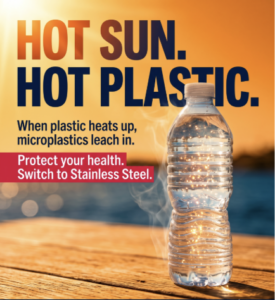
It isn’t just our balance sheet taking a hit – it’s our health.
PET plastic breaks down rapidly when exposed to heat and UV light. Think about the journey a single-use plastic water bottle takes before it reaches your lips:
- It sits in metal shipping containers crossing the ocean under intense tropical heat.
- It sits on sunny docks and in unconditioned warehouses.
- It sits in the back of delivery trucks and hot parked vehicles.
When PET plastic is heated, the chemical bonds degrade, leaching trace chemical additives like antimony and phthalates into the drinking water.
Even worse, sun-degraded plastic sheds microscopic fragments: microplastics and invisible nanoplastics. When you drink bottled water that has been sitting in the sun or heat, you are swallowing millions of microscopic plastic particles that pass through your gut lining and enter your bloodstream.
4. Mosquitoes & Marine Toxins
When PET bottles escape into the environment, they create long-lasting ecological hazards:
- Disease Vectors: In a tropical climate, a discarded water bottle becomes a long-lasting breeding site for Aedes aegypti mosquitoes, raising local risks of dengue fever. Approximately 200 mosquitoes can breed in a single water bottle cap.
- Ocean Degradation: Wave action and UV rays break bottle litter into microplastics that marine life consume, polluting the marine food web our community relies on.
5. A Message for Business Leaders & Policy-Makers
The data is clear: we cannot recycle our way out of the plastic bottle problem.
This is why upcoming policy moves – such as banning single-use plastic water bottles in schools and government offices, as well as setting minimum size restrictions on imported plastic bottles – are not just environmental ideas; they are economically sound, forward-thinking decisions for public health and territorial resilience.
For businesses, switching away from single-use PET bottles to localized refilling or filtered systems reduces import costs, protects employee health, and aligns with the growing global demand for eco-conscious tourism.
6. What You Can Do Today: Say NO to Single-Use Plastic Water Bottles!
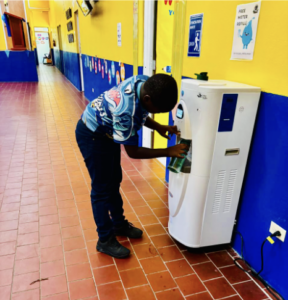 Recycling is a costly last resort. The real solution is stopping the problem at the source.
Join the “Our Water” Campaign and take these simple steps today:
- SAY NO to Buying Plastic Water Bottles: Refuse single-serving PET water bottles whenever you shop or dine out.
- Utilise Territory Refill Stations: Take advantage of the expanding network of refill stations and school filling stations across the islands.
- Upgrade Your Home & Work Setup: Install a quality multi-stage water filtration or remineralization system at home or in the office.
- Carry a Quality Reusable Flask: Make carrying a durable stainless steel or glass water bottle a daily habit for you and your family.
Recycling plastic is a costly cure. Choosing to reduce and refill is the real key to a clean, healthy, and resilient BVI.
Recent Comments