
From recovering abandoned fishing nets to rethinking plastic waste as a resource, Green VI and Beyond the Reef are working together to protect the waters, wildlife, and way of life that make the British Virgin Islands extraordinary.
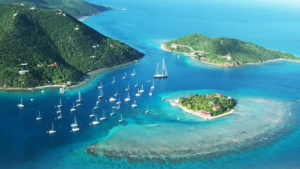
There is something about the waters of the British Virgin Islands that stays with you.
For Beyond the Reef’s Ben Trundley, it was seeing a whale in BVI waters for the first time. The encounter was a powerful reminder that the ocean is part of something much bigger than ourselves: a vast, interconnected ecosystem whose health matters far beyond what we can see.
For generations, the ocean has been the heartbeat of the Virgin Islands. It feeds our families, supports our livelihoods, shapes our culture, and draws visitors from around the world to experience the beauty we are fortunate to call home.
In 2025 alone, the BVI welcomed a record-breaking 1.2 million visitor arrivals, including more than 300,000 overnight visitors. Behind those numbers are unforgettable experiences: sailing between our islands, diving beneath the surface to explore vibrant reefs and historic shipwrecks, discovering secluded beaches, and experiencing the warmth of our island communities. These are more than memories made in paradise; they are the foundation of a tourism industry that sustains livelihoods across the territory.
Yet, beneath the beauty that brings so many people to our shores, another story is unfolding.
What Lies Beneath the Beauty
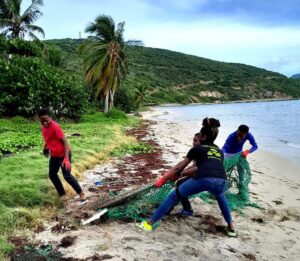
Look a little closer at the beauty of the BVI, and you may notice little pieces that don’t belong. Plastic bottles washed ashore on a secluded beach. Food wrappers caught among the mangroves. Fragments of fishing nets tangled along the reefs. These are reminders of a growing threat to the very waters and wildlife that make our islands extraordinary.
And what we can see is only part of the problem.
Across the north-eastern Caribbean, surveys have documented concentrations of up to 200,000 pieces of plastic per square kilometre of ocean surface. Plastic bottles, single-use packaging, and polystyrene foam are among the most common types of litter found along Caribbean shorelines.
Beneath the surface, the consequences can be even more troubling. Beyond the Reef’s marine biologist Elanor Trigg recalls discovering a trunkfish trapped inside an abandoned fishing pot—a firsthand reminder of ghost fishing, when lost or abandoned equipment continues to trap and harm marine life long after its use.
Across the BVI, plastic debris and abandoned fishing gear accumulate along coastlines, within floating Sargassum seaweed, and around sensitive underwater habitats. Ghost nets can entangle larger marine animals, including whales, while plastics can damage reefs and threaten the interconnected ecosystems that support marine biodiversity.
For years, local organisations have been working to turn the tide. Beyond the Reef has combined marine debris recovery with artificial reef projects, marine research, and education to restore and protect underwater habitats. Meanwhile, Green VI has helped establish the Territory’s first recycling centres, creating opportunities to recover valuable materials before they become pollution.
But these efforts are only the beginning. Because while the BVI can take action to protect its own shores, the ocean, and the pollution travelling through it knows no borders.
An Ocean Without Borders
The same currents that connect our islands to the wider Caribbean and the world can also carry marine litter across thousands of miles.
At Long Bay Beach on Beef Island, Green VI’s cleanup teams often find familiar signs of local activity: food wrappers, cigarette butts, bottles, and other recently discarded items.
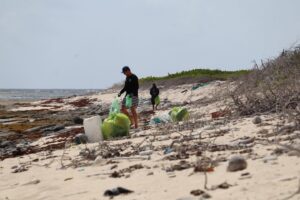
But travel to remote coastlines such as northern Anegada or the back of Cooper Island, and the story changes. Plastic may be faded and brittle, crumbling at the touch. Bottles can be covered in barnacles and sand—signs that they have spent considerable time travelling through the ocean.
Beyond the Reef has even recovered drifting fish aggregating devices (FADs) equipped with transmitters unlike those typically used in local waters, suggesting they originated beyond the BVI.
While it’s not always possible to identify where marine litter originated, the message is clear: pollution from elsewhere can reach BVI shores, just as waste escaping our islands can affect neighbouring communities.
This shared responsibility is at the heart of PROMAR (Prevention of Marine Litter in the Caribbean Sea), a regional initiative implemented locally by Green VI in partnership with the Ministry of Environment, Natural Resources and Climate Change.
Through PROMAR, Green VI and its partners are doing more than collecting litter. They’re monitoring where waste accumulates, educating communities, strengthening waste management policies, and developing circular economy solutions that prevent plastics from reaching the ocean in the first place.
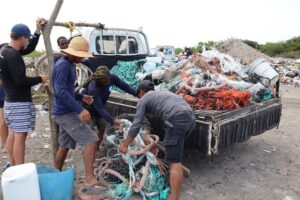
Together, Green VI and Beyond the Reef have removed nearly 6,000 pounds of marine litter across eight coastal cleanups, including more than 2,800 pounds of abandoned fishing gear. Beyond the Reef’s expertise and resources help teams reach remote shorelines where some of the most harmful debris accumulates.
And the initiative’s impact extends beyond the shoreline. The PROMAR BVI Initiative has engaged approximately 900 participants through cleanups and workshops, supported the drafting of two plastics management policies, and launched a circular economy pilot study to explore solutions that address waste at its source.
Because while every cleanup removes an immediate threat, the ultimate goal isn’t simply to collect more litter. It’s to stop it from reaching our ocean in the first place.
The Plastic Problem Doesn’t End When We Throw It Away
Here’s the uncomfortable truth about plastic: throwing it away doesn’t make it go away.
Plastic is durable by design. Yet a single-use water bottle enjoyed for just a few minutes can take an estimated 450 years to break down. As sunlight, waves, and physical wear break plastic into increasingly smaller fragments, they create microplastics and nanoplastics that are difficult to recover from the environment. These particles have been detected in our food, water, air, and human tissues. Scientists are still investigating their long-term health effects, but their widespread presence raises serious questions about our exposure and the legacy of plastic pollution.
The consequences extend beyond microplastics: Discarded containers can collect rainwater and become breeding sites for mosquitoes. Plastic waste can clog drainage channels, contribute to flooding, and harm marine animals through ingestion or entanglement.
Environmental health is public health.
For small islands like the BVI, the challenge is especially pressing. We depend heavily on imported goods, have limited space for waste disposal, and live surrounded by the very waters that improperly managed waste can enter.
Green VI’s beach sampling has found that plastics are a major component of the debris accumulating along our shores, with lost or discarded fishing gear another significant contributor. These findings reinforce an important truth: protecting our ocean begins with what happens on land.
Rethinking Waste as a Resource
So what do we do with the plastic already circulating throughout our islands? Green VI is helping the BVI think differently.
We’ve all heard the familiar message: Reduce. Reuse. Recycle.
But what if we started asking another question?
What if we stopped throwing away potential so that yesterday’s waste became tomorrow’s resources?
This is the idea behind a circular economy: instead of constantly importing, using, and discarding materials, we rethink waste as a resource material.
For an island territory that relies heavily on imported goods, that means keeping valuable materials in productive use for as long as possible rather than allowing them to become pollution.
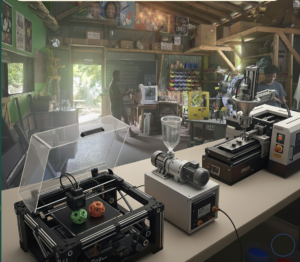
An exciting next step is Green VI’s upcoming Plastics Fab Lab, a space designed to demonstrate this idea in action.
Using processes such as shredding, melting, and moulding, the Fab Lab will transform suitable plastics—specifically #2, #5, and #6—into useful, higher-value items.
Think laundry detergent bottles, yoghurt containers, and certain foam packaging becoming outdoor furniture for beaches and resorts, recycling stations for homes and business, or planter boxes for your garden.
Visitors will be able to see how discarded materials are transformed, explore locally made souvenirs, and discover a different side of sustainability in the BVI.
The Fab Lab also aims to inspire local entrepreneurs, offer practical workshops to develop new skills, and create opportunities for tourism partners to introduce visitors to the BVI’s growing circular economy.
It’s an approach that shares something fundamental with Beyond the Reef’s artificial reef projects: the willingness to look at something discarded and imagine a different future for it.
Beyond the Reef shares this same spirit of innovation, reimagining discarded vessels and aircraft as thriving artificial reefs and unforgettable underwater attractions. From the legendary Willy T and historic Kodiak Queen to the shark-inspired Sharkplaneos, these installations demonstrate how something once considered waste can find new purpose, creating habitats for marine life while inspiring visitors to explore and protect the BVI’s underwater wonders.
Of course, recovering and repurposing plastics and debris is only part of the answer. Not every material can be recycled indefinitely, and the most effective way to prevent unnecessary plastic pollution is to reduce it at its source.
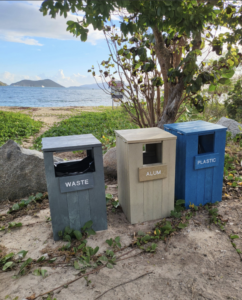
That’s why Green VI’s work through PROMAR also includes beach monitoring, public education, and practical prevention initiatives.
At Long Bay Beach on Beef Island, a demonstration project featuring waste and recycling stations is helping make responsible waste disposal easier for beachgoers and vendors.
The bigger vision is one where protecting paradise becomes part of everyday life.
Protecting Paradise Starts With Us
Keeping the BVI beautiful is not the responsibility of any one organisation, government department, or group of conservationists. It belongs to all of us.
To the fishermen and boat captains whose livelihoods depend on healthy waters. To the businesses welcoming visitors to our shores. To the families spending their weekends at the beach. To the students discovering the wonders of the ocean for the first time. To every visitor who has fallen in love with these islands.
Simple actions can make a difference: carry a reusable water bottle, refuse unnecessary single-use plastics, dispose of waste responsibly, secure rubbish onboard boats, and participate in community cleanups.
Hotels, restaurants, and charter operators can help by providing refillable water options, reducing unnecessary packaging, and making responsible waste disposal easier for their guests.
But perhaps the most important step is remembering why these actions matter.
Beyond the Reef hopes the next generation will inherit thriving coral reefs, abundant marine life, and the chance to encounter extraordinary animals like whales and sharks in their natural environment.
It’s a vision worth protecting.
Our ocean is more than a beautiful backdrop for photographs or a destination on a travel itinerary. It is our home, our livelihood, our playground, our connection to one another, and part of the legacy we leave for generations to come. Through the work of Green VI, Beyond the Reef, and the many partners and volunteers joining this movement, the BVI is demonstrating what can happen when a community chooses to protect what it loves.
Our ocean is our heartbeat. Let’s keep it healthy, vibrant, and beautiful for ourselves, for our neighbours across the Caribbean, and for every generation still to come.
Small Actions. Big Waves. Contact Beyond the Reef or Green VI to take your next step to turn the tide on marine litter.
###
About the PROMAR Project
The PROMAR Project Implemented locally by Green VI in partnership with the Ministry of Environment, Natural Resources and Climate Change (MENRCC), the PROMAR (Prevention of Marine Litter in the Caribbean Sea) project is a regional initiative tackling plastic pollution at its source. Funded by the German Federal Ministry for the Environment and supported by the United Nations Environment Programme – Cartagena Convention Secretariat and adelphi, this multi-nation framework protects our critical blue economy by driving circular economy solutions to intercept single-use plastics and packaging before they ever reach our waters.
About Green VI
Green VI is a nonprofit organisation working to create a greener, cleaner, and healthier British Virgin Islands through practical projects, education, and innovation. From waste reduction and recycling to environmental health, Green VI partners with communities, businesses, and government to turn environmental challenges into opportunities for sustainable progress.
About Beyond the Reef
Beyond The Reef is a British Virgin Islands based nonprofit organisation that is working towards creating innovative ways to help our marine ecosystem while generating positive publicity for our island and educating the local community on the importance of ocean health.
Recent Comments